-
Built-Up Roofing (BUR) in Erie, PA
Built-Up Roofing on Erie's Legacy Industrial and Port Buildings
Some of the oldest commercial roofs in Erie County are still built-up systems — multiple plies of felt and asphalt topped with gravel ballast — and a good number of them sit on the industrial buildings and port-adjacent structures near the bayfront that predate the newer single-ply era by decades. We repair, restore, and selectively replace BUR systems across that older building stock.
Why BUR Is Still Up There
Built-up roofing was the standard for large flat commercial and industrial roofs for most of the twentieth century, and a lot of it was installed to last. The redundant, multi-ply construction gives these systems real staying power when they're maintained, which is why buildings tied to Erie's older manufacturing and port infrastructure still carry BUR decades after installation. Full replacement isn't always the right call on a system that's still fundamentally sound underneath a worn gravel surface.
Gravel Ballast and Lake Wind Uplift
The gravel layer on a BUR roof does more than protect the asphalt plies from UV exposure — it adds ballast weight that resists wind uplift, which matters on buildings exposed to the open wind fetch coming off Lake Erie. Buildings near the bayfront and port facilities see wind loading that inland structures don't, and a properly maintained gravel ballast layer is part of how these older roofs have stayed anchored through decades of lake-driven storms.
We check ballast coverage and depth as part of every BUR inspection, since displaced or thinned gravel both exposes the membrane to UV damage and reduces the wind resistance the system was designed around.
Structural Load: Gravel Plus Snow
A BUR roof's dead load is already higher than a single-ply membrane system before any snow falls, because of the gravel ballast and multiple asphalt plies. Add a heavy lake-effect snow season on top of that, and older BUR buildings need a closer look at total combined load than a lighter modern roof would.
We factor ballast weight into every snow-load assessment on a BUR building, and on structures where that combined number is getting close to rated capacity, we look at whether a lighter cap sheet or coating approach makes more sense than continuing to add material during future maintenance cycles.
Insulation Retrofits Under an Existing BUR System
A lot of these older buildings were insulated to standards from decades ago, long before Erie's heating costs and energy codes looked the way they do now. When we're doing significant repair or recover work on a BUR roof, we look hard at whether an insulation retrofit makes sense as part of the same project, since adding insulation value under or over an aging built-up system can meaningfully cut a building's winter heating load without a full roof replacement.
Common BUR Failure Points
- Blistering between plies from trapped moisture
- Displaced or thinned gravel ballast exposing bare asphalt
- Ponding water at structural low points
- Cracked or deteriorated base flashing at parapets
- Split felt plies from age and thermal cycling
- Saturated insulation beneath an intact-looking surface
Where BUR Still Covers Erie's Roofs
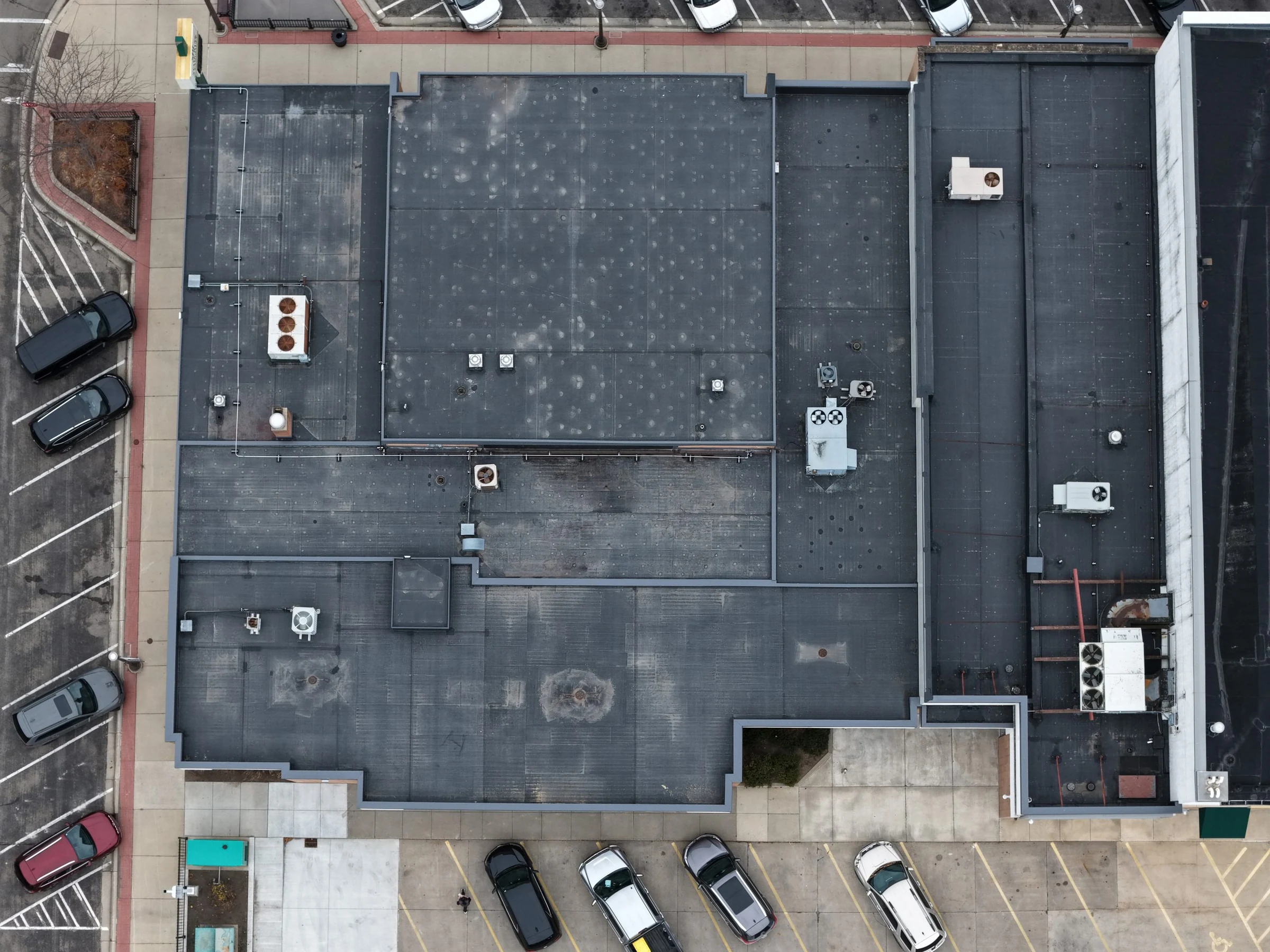
The oldest sections of Erie's industrial and manufacturing corridor, buildings near the bayfront and port operations, and some of downtown's larger legacy commercial structures still carry built-up systems, often patched and re-coated across multiple maintenance cycles rather than fully replaced.
Coating a BUR Roof for Reflectivity and Life Extension
A gravel-surfaced BUR roof can be coated once the ballast is removed or where a smooth-surfaced BUR variant is already in place, and that coating pass does two things at once: it restores UV protection to asphalt plies that have been exposed by wear or thinned ballast, and it adds a measure of reflectivity that a bare gravel surface doesn't offer. On buildings near the bayfront where summer sun reflecting off open water adds extra heat load to south-facing roof sections, that reflectivity improvement is a meaningful comfort and cooling-cost benefit.
We treat a BUR coating project as a full inspection opportunity, checking every seam, flashing detail, and drain before committing a new surface over decades of accumulated repairs, since a coating only performs as well as the substrate underneath it.
Common Built-Up Roofing Questions
Does a BUR roof need full replacement once it starts blistering?
Not necessarily. Localized blistering often gets cut out and patched, and a broader coating or recover project can extend a fundamentally sound BUR system well beyond what a full tear-off would justify cost-wise.
Is gravel ballast really necessary on a BUR roof near the lake?
Yes, in most cases. The ballast weight is part of the system's wind resistance, and buildings exposed to Lake Erie's open wind fetch benefit from that resistance more than sheltered inland structures do.
Can you add insulation to an old BUR roof without a full tear-off?
Often yes, depending on the roof's current condition and deck structure. We evaluate whether an insulation overlay or recover approach fits the existing system before recommending a full replacement.
How do you check if a BUR roof's snow load is within safe limits?
We calculate combined dead load from gravel ballast, multiple asphalt plies, and any accumulated snow, then compare that against the building's rated structural capacity.
What's the biggest maintenance issue on older BUR roofs here?
Trapped moisture between plies, usually from a small breach that went unnoticed for a season or more. Regular inspection catches it before it spreads into widespread blistering.
Ready to review the roof scope?